Floor Tile Installation in Bakersfield, CA
Bakersfield Keystone Tile & Pavers installs floor tile throughout Bakersfield, CA with over 20 years of experience. Living rooms, hallways, entryways, kitchens, and light commercial spaces. We handle subfloor prep, self-leveling compound, tile setting, and sealing — start to finish.
Floor Tile Material Options
Not all tile is the same. Here's an honest breakdown of the materials we install most often — and the tradeoffs between them.
Porcelain Tile
The most durable floor tile option. Fired at higher temperatures than ceramic, which makes it denser and more resistant to water, scratches, and heavy foot traffic. You don't need to seal it. Our top recommendation for kitchens, entryways, and any area that gets real use.
Ceramic Tile
Less dense than porcelain, but it handles moderate traffic well and comes in a wider range of styles and price points. Good for bedrooms, secondary bathrooms, and spaces that don't see heavy use. Budget-friendly and easy to replace if damage occurs.
Natural Stone
Travertine, slate, and marble bring a character that manufactured tile can't replicate — every piece is different. The tradeoff: stone is porous and needs annual sealing. We talk through the maintenance expectations upfront so there are no surprises two years later.
Large-Format Tile
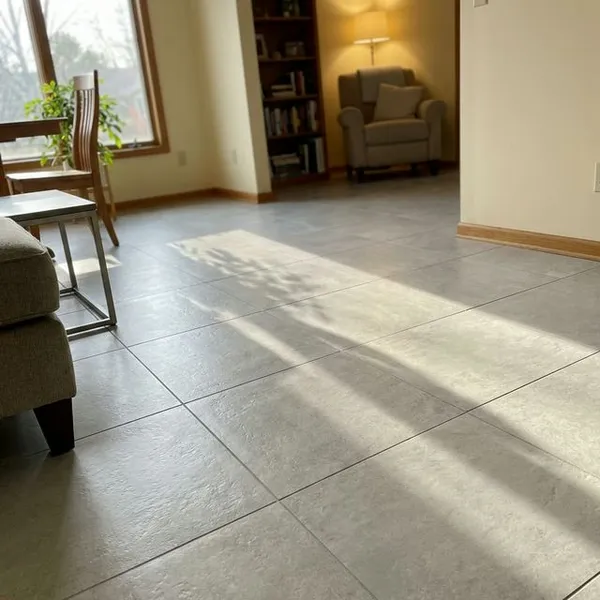
Tiles 18×18 and larger are trending for good reason — fewer grout lines make floors look cleaner and more open. They're harder to install correctly because the substrate has to be nearly perfectly flat. We use self-leveling compound when needed to make large-format work right.
Subfloor Prep Is What Separates a Good Install from a Failed One
Tile doesn't flex. The surface underneath it has to be rigid, flat, and solid — or the tile and grout will crack within a year. A lot of installers skip this step or do it halfway. We don't.
Before we set a single tile, we check the subfloor for flex, bounce, and level. If there's movement, we address it. If the floor is out of plane by more than 1/8" over 10 feet, we use self-leveling compound to bring it into spec.
- Subfloor inspection for flex and moisture before installation
- Self-leveling compound when needed for large-format tile
- Cement board or Schluter DITRA membrane over wood subfloors
- Expansion joints at walls and doorways to prevent cracking
- Full grout sealing on all non-porcelain surfaces
How long do tile floors last?
Properly installed porcelain or ceramic tile floors routinely last 20–30 years. The grout may need resealing every 5–10 years depending on traffic and cleaning habits. Natural stone needs annual sealing.
Can tile go over existing flooring?
Sometimes. It depends on what's there, how level it is, and whether the subfloor can handle the added height and weight. We assess this on-site — it's not a question that can be answered over the phone.
Residential vs. commercial — what's different?
Commercial spaces need higher-rated tile (PEI rating 4 or 5 for heavy traffic), wider grout joints in some cases, and DCOF (wet coefficient of friction) compliance for safety. We specify the right tile for the application, not just the cheapest option that fits.
Frequently Asked Questions
How long does floor tile installation take?
A typical 200–300 square foot residential floor takes 3–5 days: demo and subfloor prep on day 1, tile setting on days 2–3, mortar cure on day 4, and grouting and sealing on day 5. Larger rooms or complex patterns take longer. We give you a written schedule before we start.
Do you need to remove furniture?
Yes — we need clear access to the full floor area. We recommend having furniture moved to another room before we arrive. For large pieces, we can discuss options on-site. We do not move furniture ourselves.
What's the difference between porcelain and ceramic for floors?
Porcelain is denser, harder, and more water-resistant. It costs more per square foot but lasts longer and doesn't require sealing. Ceramic is softer and more affordable — good for areas that don't take heavy traffic. Both work well; the right choice depends on where and how the floor gets used.
Can you install heated tile floors?
Yes. We install electric radiant heat mats (such as Schluter DITRA-HEAT) before setting tile. The mat goes over the subfloor, the tile goes on top. We coordinate with the electrician for the thermostat connection. It's more common in bathrooms, but it works in any room.
Get Your Floor Tile Project Quoted
Tell us the room, the square footage, and what you're thinking for material. We'll come out, measure, and give you a written fixed-price estimate.