Heat-Resistant Outdoor Porcelain Pavers in Bakersfield, CA
Bakersfield Keystone Tile & Pavers installs heat-resistant outdoor porcelain pavers in Bakersfield, CA — the premium evolution of traditional concrete paving. Fired at over 1200°C, porcelain pavers are virtually impervious to staining, moss growth, and UV fading, making them the definitive long-term outdoor flooring solution for Kern County's demanding climate.
Porcelain Pavers vs. Concrete: A Superior Choice
Homeowners are shifting away from traditional poured concrete toward porcelain pavers for compelling reasons. Standard concrete requires periodic sealing, stains easily from oil and rust, and fades significantly under Kern County's relentless UV exposure. Porcelain requires none of this maintenance.
The advanced manufacturing process justifies the premium price point: porcelain pavers are crafted from highly refined clays and fired at temperatures exceeding 1200°C, resulting in an exceptionally dense, vitrified, non-porous tile. The surface can be cleaned with standard dish soap and water without degrading the structural integrity — year after year.
- No sealing required — ever
- UV-stable color that does not fade or chalk over decades
- Incredibly low thermal expansion — will not warp or crack
- Completely impervious to moss, algae, and staining
Heat Resistance for Bakersfield's Summers
Porcelain pavers absorb less heat than dark concrete or asphalt, making them noticeably more comfortable under bare feet in triple-digit temperatures. A direct pain point for Bakersfield homeowners with outdoor entertaining spaces.
Long-Term Financial Value
While the upfront material cost exceeds basic concrete, the complete elimination of sealing, stain treatment, and periodic resurfacing yields superior total cost of ownership over a 15–20 year lifespan.
Design Versatility
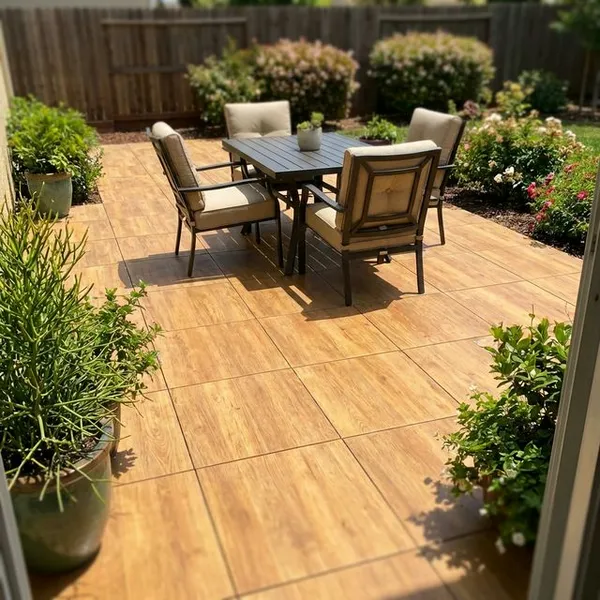
Available in wood-plank, natural stone, concrete, and abstract formats — large porcelain pavers create a high-end aesthetic for outdoor kitchens, al fresco dining areas, and poolside terraces.
Where Outdoor Porcelain Pavers Excel
Porcelain pavers perform well in every outdoor application — but they truly shine in high-exposure environments where other materials consistently struggle.
Pool Deck Surrounds
Porcelain pavers are ideal for pool surrounds because they resist chlorine, saltwater, and pool chemicals without degrading. Their textured surface provides slip resistance when wet, and their zero-porosity prevents the biological staining common in travertine joints near pools. No sealing means no maintenance headaches year after year.
Outdoor Kitchens and BBQ Areas
Heat and grease splatter from outdoor cooking stations are no match for vitrified porcelain. Unlike natural stone, which stains permanently from cooking oils, porcelain cleans up with a damp cloth. The non-porous surface also resists the thermal shock from dropped hot grill grates or cooking utensils.
Patio and Al Fresco Dining Areas
Large-format outdoor porcelain (24"x24" and larger) creates a sophisticated, nearly seamless outdoor floor that photographs beautifully and maintains its appearance for decades without annual sealing cycles. Available in warm stone tones, cool concrete looks, and natural wood grain finishes to suit any design direction.
Driveway Aprons and Entry Walkways
Thicker outdoor porcelain pavers (20mm) are rated for light vehicular use, making them a premium choice for driveway aprons and front-entry walkways where visual impact matters. Their consistent factory color and surface finish creates a polished, uniform appearance that hand-set natural stone cannot match.
Outdoor Porcelain Paver Installation Requirements
Outdoor porcelain installation requires different techniques than standard concrete paver laying. The material's density and large format demand specialized tools and more exacting substrate preparation.
Rigid or Semi-Rigid Base
Unlike traditional sand-set pavers, outdoor porcelain can be installed over a concrete substrate or a rigid pedestal system. We assess site conditions and select the appropriate base method to prevent flexing that can crack large-format slabs over time.
Wet-Saw Diamond Blade Cutting
Outdoor porcelain is extremely hard — far harder than ceramic tile. Cutting requires continuous-rim diamond blades designed specifically for dense porcelain. This prevents edge chipping and ensures clean, precise cuts at corners and irregular shapes.
Suction Cup Handling
Large-format porcelain pavers (20mm thick, 24"x48" or larger) are moved and positioned with pneumatic suction cups to prevent breakage and finger-edge chipping during placement. Manual handling at this size risks both injury and material damage.
Frequently Asked Questions
Are outdoor porcelain pavers slippery when wet?
No — when you specify the correct product. Outdoor porcelain pavers designed for exterior use carry a COF (Coefficient of Friction) rating and are textured to provide slip resistance in wet conditions. We only specify R10 or R11-rated porcelain for pool decks and wet areas. Highly polished porcelain that works indoors is never recommended for exterior applications.
How do outdoor porcelain pavers hold up to frost and temperature swings?
Outdoor porcelain pavers have a water absorption rate below 0.5%, which means they are frost-proof — water cannot penetrate the surface and freeze-crack the material. In Bakersfield, where frost is rare but temperature swings between day and night can be significant, this low thermal expansion rate is a major advantage over natural stone and concrete.
Can outdoor porcelain pavers be installed over existing concrete?
Yes, in many cases. We can install outdoor porcelain over an existing concrete slab using a full-mortar bed or proprietary pedestal system, provided the slab is structurally sound and properly sloped. This avoids demolition costs and reduces project time. We assess slab condition during your free estimate to confirm suitability.
How do outdoor porcelain pavers compare in cost to travertine?
Outdoor porcelain is typically priced comparably to premium travertine per square foot on material cost. Where porcelain offers a clear financial advantage is in the long-term: zero sealing costs, no stain treatment, and no resurfacing over a 20+ year lifespan. Travertine requires sealing every 1–2 years and periodic grout maintenance, which adds meaningful cost over time.
Invest in Outdoor Flooring That Lasts Decades
Contact us for a free estimate on outdoor porcelain paver installation in Bakersfield. No sealing. No fading. No maintenance headaches.